
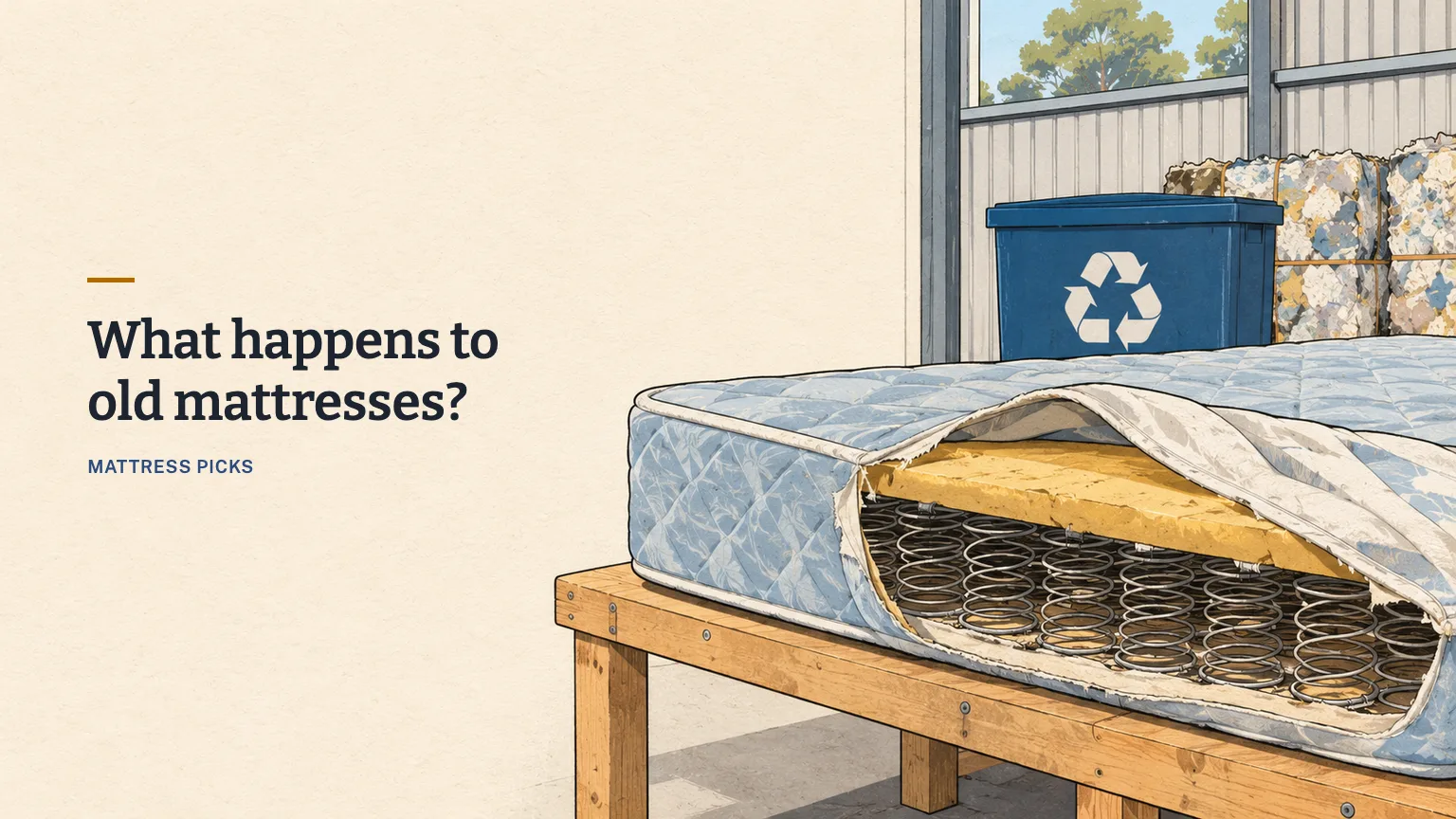
In the sources we reviewed, there is no single settled figure for how many mattresses go to landfill in Australia. Two national estimates are about 740,000 and about 800,000 mattresses. Both trace to the Australian Bedding Stewardship Council (ABSC), which runs an industry scheme for dealing with old bedding, or to analysis it commissioned. One source counts waste-to-energy within the 740,000.
How many are thrown out, and how many are buried?
A study commissioned by the ABSC adopted an estimate of 1.8 million mattresses reaching the end of their life each year. That is all mattresses thrown out, not the number landfilled. It is a modelled estimate, and the ABSC’s FY25 annual report attributes it to 2019 data.
For landfill, a federal environment department page, last updated 24 November 2023, cites the ABSC in giving around 740,000 mattresses going to landfill. The model in that ABSC-commissioned study, dated January 2021 and covering the 2020 calendar year, shows about 740,000 going to “landfill or waste-to-energy”. It is a modelled figure, not a count, and the sources we reviewed do not explain the difference in wording.
Waste-to-energy means waste is processed to produce energy in a usable form, such as heat or electricity. This can leave leftovers. A draft guide to national waste data, prepared for the federal environment department, notes that leftovers from these facilities can be recycled, sent to landfill or otherwise disposed of.
In 2022 the Australian Competition and Consumer Commission (ACCC) cited ABSC-commissioned analysis estimating that 800,000 whole mattresses go into landfill each year.
The ABSC’s own 2022 application to the ACCC said data on the proportion landfilled may not be very accurate, because there is no consistent recording or reporting.
Why the numbers are hard to compare
The figures cover different things. Some count all mattresses thrown out and others only those going to landfill. Some cover the whole country and others one area, in different years.
A figure of 1.25 million mattresses to landfill appears in publications we reviewed, dated 2009 to 2019, including a 2009 Western Australian Government statement and a 2019 Randwick City Council news release. Our review could not establish its underlying source or method. A fall from 1.25 million to 740,000 cannot be concluded, because the sources do not show the two were estimated the same way.
Some states give their own figures. The Queensland Government estimates about 300,000 mattresses go to landfill a year. It states no method or reference year. Western Australia’s WasteSorted page says around 150,000 mattresses a year are sent to landfill in metropolitan Perth. It also states no method or reference year.
What recyclers report
From July 2024 to June 2025 (FY25), ABSC-approved recyclers reported processing 972,538 mattress units. The same report splits the work into 437,794 mattresses dismantled and 489,280 shredded. On our arithmetic, those two add to 927,074, which is 45,464 (4.7%) fewer than the total. The report notes “some anomalies in numbers” because shredded mattresses are weighed rather than counted one by one. We found no calculation in it that closes the gap. This is a difference between published totals, not a count of mattresses lost or landfilled.
The number of approved recyclers rose from eight to 13 during the year.
In an August 2026 message calling for more of the industry to join its scheme, the ABSC’s chief executive wrote that the approved recycler network processed more than 1.1 million mattresses in FY26. The message gives no breakdown of that total.
Both totals cover approved recyclers only, not the whole industry. They should not be set against the 1.8 million to work out a national recycling rate. Processing, recycling materials, recovering energy and keeping material out of landfill are different outcomes.
What can come out of an old mattress
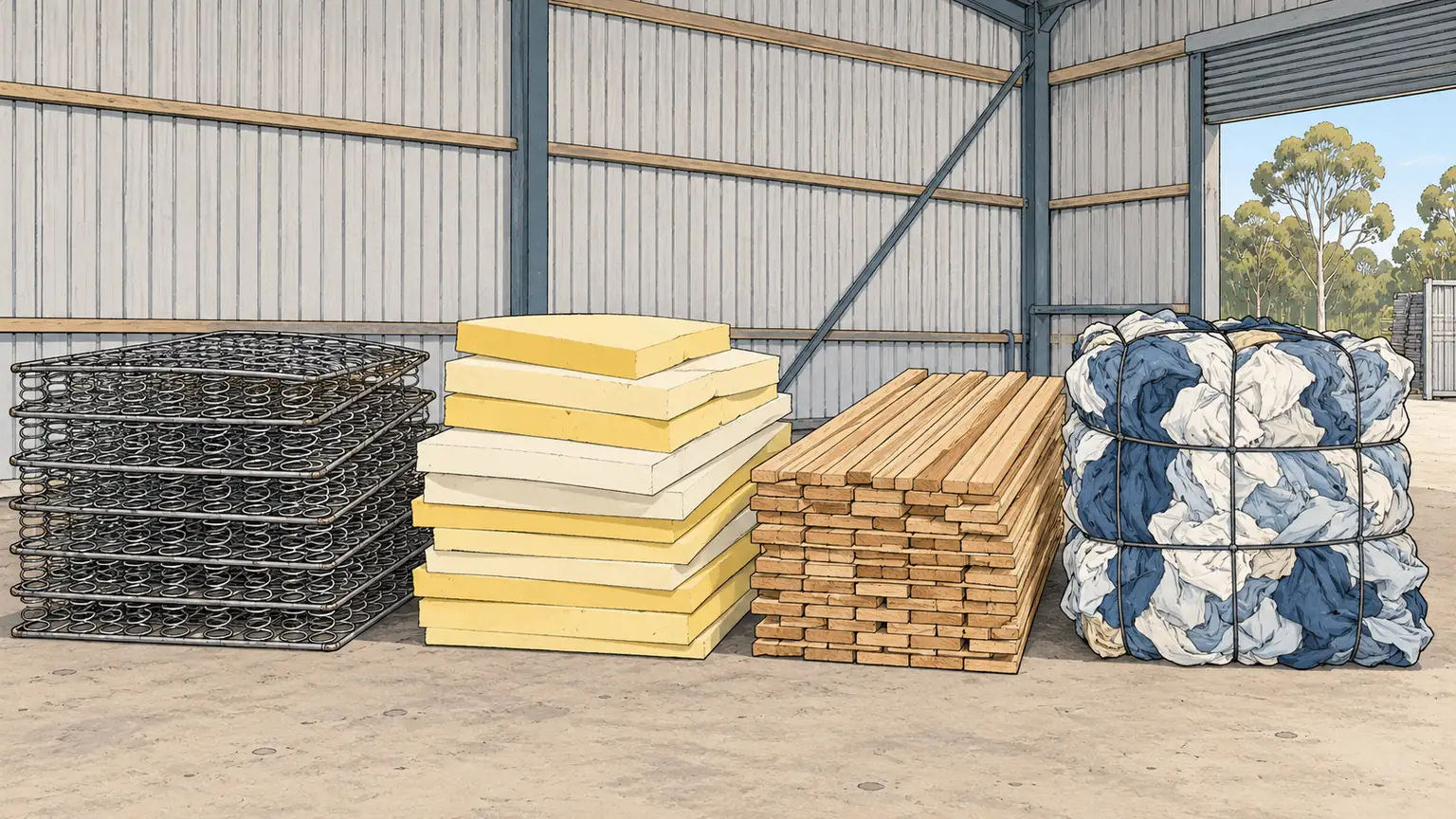
Soft Landing, a mattress recycling social enterprise listed as an approved recycler in the ABSC’s FY25 report, reports that in FY26 it recycled 369,501 mattresses, diverting 7,610 tonnes of material from landfill. It lists these amounts:
What Soft Landing lists for FY26, in tonnes
These four amounts add to 7,610 tonnes, on our arithmetic. That means the headline figure includes the textiles used for energy, which is not the same as recycling them into new material. The same page says Soft Landing extended this work in Perth to lounges and couches, and gives no separate tonnage for them.
This is one operator’s own reporting and should not be added to the ABSC totals.
What we still do not know
In the parts of the sources we examined, we did not find a measured national count of mattresses sent to landfill for a stated year. We also did not find a state-by-state count of mattresses thrown out, or one reconciled national figure covering mattresses thrown out, collected, processed, recovered and disposed of in the same period. This does not mean such data does not exist elsewhere.
This explainer is based on our review of published sources in November 2026. The review was selective, not exhaustive, and collected no new data. For every source and its limits, read the summary or the full review.